
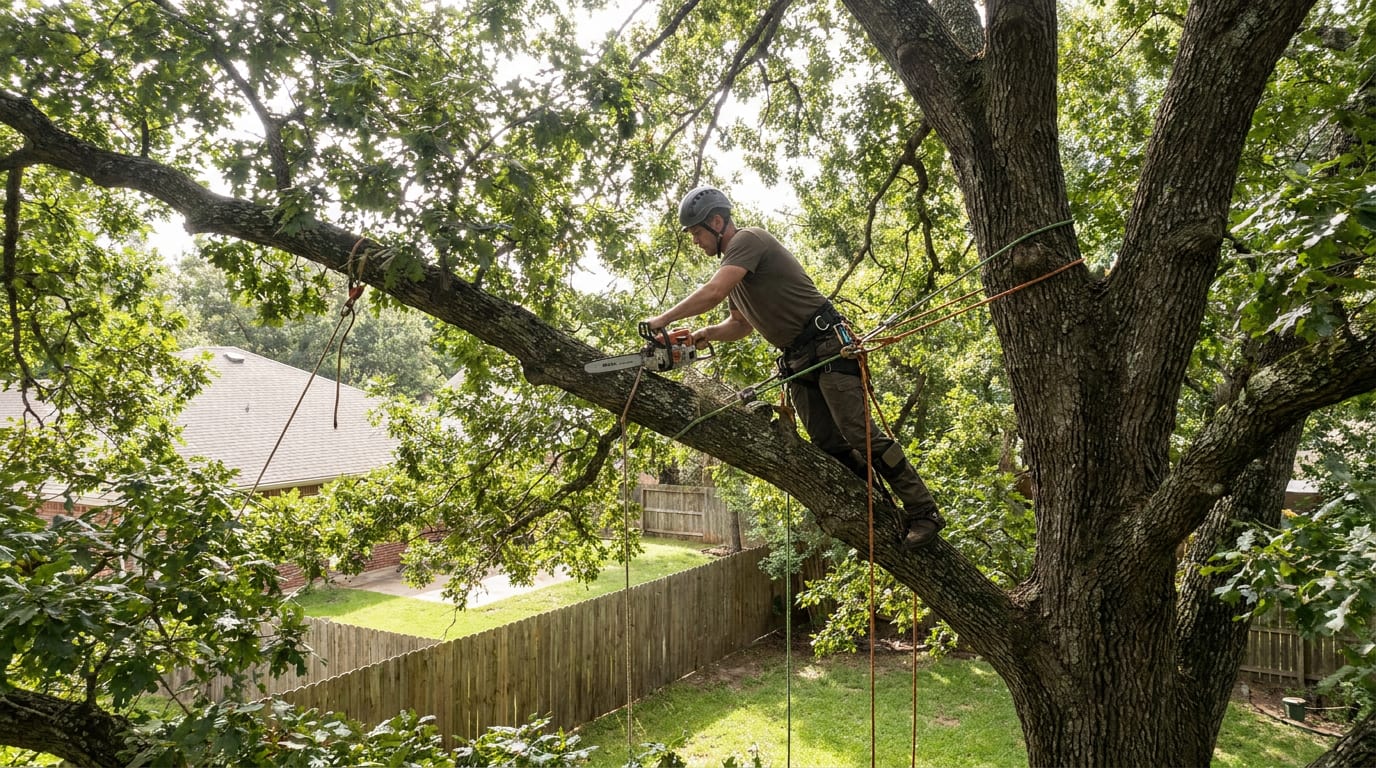
· by Michael Blair, Nashville's Tree Service
The Bradford pear was the subdivision tree of Middle Tennessee for a generation. It grew fast, bloomed white in March, turned red in fall and stayed a tidy oval, which is why so many subdivision streets in Williamson, Sumner, Rutherford and Wilson counties were planted with them. It also has a built-in structural flaw that shows up right as the tree reaches full size. If you have a mature one near the house, the drive or a fence, it is worth understanding how it fails before the next ice storm makes the decision for you.
Why do Bradford pears split?
A Bradford pear sends up many upright limbs from nearly the same spot on the trunk, all at steep, narrow angles. As those limbs thicken, bark gets pinched between them instead of forming a strong collar of wood, and the union is held together by little more than that. Arborists call it included bark. On a young tree it does not matter. On a tree twenty-some years old with heavy limbs pulling outward, it is the weak point everything else hangs from.
When it goes, it goes all at once: a whole limb, often a third or half of the crown, peels away from the trunk and takes a long strip of bark with it. Wind from a spring storm does it, and so does the weight of ice or wet snow, and a pear that has not yet dropped its leaves carries more of that weight than a bare tree would.
Why are fall and winter risky for Bradford pears?
Bradford pears hold their leaves late, often into late November, well after the oaks and maples around them are bare. An early ice event or a heavy wet snow on a crown still in full leaf is the classic way these trees split here. A tree that made it through the summer storms is not out of the woods in November.
That is one reason late fall and winter are good times to deal with a pear you are worried about. The ground is usually firm enough for equipment, the tree is easier to read once it is bare, and taking it down before the ice season removes the risk rather than waiting to see.
Pruning, cabling or removal
On a young pear, perhaps under ten years, structural pruning can help: choosing one central leader, removing competing upright stems early, and thinning so the limbs that remain have wider angles. That has to start young and be repeated, and even then the tree will not become a strong one. It only buys time.
On a mature tree, the honest answer is usually removal. Cabling and bracing can support a valuable tree with a weak union, but it is a long-term commitment with inspections, and few people want to spend that on a tree that is short-lived to begin with. A pear that has already split should come out entirely; the half left standing has the same flaw and a fresh wound at its base.
- Several large limbs rising from one point on the trunk
- A dark vertical seam or crack where two limbs meet
- Sap or rot staining below a crotch
- A crown that has started to lean or open up on one side
The invasive side, and what to plant instead
Bradford is one variety of Callery pear. On its own it sets little fruit, but it cross-pollinates with other Callery varieties planted nearby, birds spread the seed, and the result is the thorny wild pear thickets that now fill roadsides, old fields and the edges of greenways across the region. Callery pear appears on Tennessee’s invasive plant lists for that reason. Its stump also sprouts readily, so a removal should include grinding or treating the stump.
Fall is a good time to replant, because roots keep growing in cool soil after the top has gone dormant. For a spring-flowering tree of similar size, eastern redbud, serviceberry and flowering dogwood are all native here. For red fall color on a bigger tree, blackgum is slow to start but strong and long-lived.
FAQ
Bradford Pears: Why They Split and What to Do — questions
Can a split Bradford pear be saved?
Rarely in any useful way. The remaining limbs share the same weak unions, the tree is lopsided, and the tear leaves a large wound open to decay. Removing the rest of the tree is almost always the safer and cheaper choice over the next few years.
How long do Bradford pears live?
They often start splitting at around fifteen to twenty-five years, which is when the limbs get heavy enough to pull the weak unions apart. Some last longer in sheltered spots, but few reach the age of a typical shade tree.
Will a Bradford pear stump grow back?
It can. Callery pear sprouts from the stump and roots after cutting, so grind the stump below grade or have it treated right after the tree comes down, and pull any sprouts that appear the following spring.
How do Bradford pear trees spread?
A Bradford sets little fruit on its own, but it cross-pollinates with other Callery pear varieties planted nearby, and birds carry the seed. That is how thorny wild pear thickets ended up along roadsides, old fields and greenway edges, and why Callery pear is on Tennessee’s invasive plant lists. The stump also resprouts after cutting.